Cybersecurity in the Age of AI: Why Security Must Adapt Without Starting Over
Introduction
Artificial intelligence is no longer a contained technology experiment. It is embedded into customer engagement, software development, decision support, knowledge management, security operations, and business process automation. As AI moves into operational workflows, it changes the cybersecurity question leaders must answer. The issue is not whether AI creates new risk; it does. The more important question is whether organizations can govern AI-enabled systems with the same discipline they apply to other critical enterprise assets.
AI creates risk in three ways. It helps defenders analyze threats and respond faster. It helps adversaries scale phishing, social engineering, reconnaissance, and attack automation. It also becomes an asset that must be protected: models, prompts, agents, retrieval systems, vector databases, datasets, APIs, plug-ins, and third-party AI services now form part of the enterprise attack surface (National Institute of Standards and Technology [NIST], 2024; OWASP Foundation, 2025).
The strategic mistake would be to treat AI security as either a completely new discipline detached from cybersecurity or as merely another application security checklist. AI security is best understood as an extension of enterprise cybersecurity: the same foundations still matter, but they must be adapted to systems that can generate content, retrieve information, use tools, make recommendations, and in some cases initiate actions.
For executives, the implication is clear. AI security is not only a technical concern; it is a governance and accountability issue. Organizations need executive ownership, risk-tiered oversight, control assurance, vendor accountability, and clear limits on autonomous behavior. The goal is not to start over. The goal is to extend proven cybersecurity principles to a new class of systems before those systems become too embedded to control.
How AI Changes the Cybersecurity Landscape
AI Increases Speed, Scale, and Plausibility
AI is increasing the efficiency of familiar cyberattack methods. Threat actors can use generative tools to produce more persuasive phishing messages, tailor social engineering attempts, automate parts of the reconnaissance process, and operate at a scale that previously required more time and labor. The primary concern is not that AI has replaced human adversaries. It is that AI lowers the cost of producing convincing malicious activity and compresses the time available for defenders to detect and respond (Microsoft, 2025; Schmitt & Koutroumpis, 2025).
This shift matters to leaders because many organizations still depend on controls designed for slower, more predictable attack patterns. AI-enabled attacks can stress identity controls, employee awareness programs, incident response timelines, fraud detection processes, and executive decision-making. Security programs must therefore emphasize resilience, automation, identity protection, and rapid verification rather than relying solely on static perimeter assumptions.
AI Is a Defensive Tool, an Offensive Enabler, and a Protected Asset
AI is unusual because it occupies several roles at once. Security teams use it to improve detection, summarize alerts, automate analysis, and accelerate response. Adversaries use it to improve the scale and quality of attacks. Business units use it to support decisions, generate content, automate workflows, and interact with customers. Each use creates value, but each also creates a governance obligation.
Executives should therefore resist the temptation to view AI security as a narrow technology matter delegated entirely to specialists. AI risk crosses business strategy, legal exposure, data governance, vendor management, operational resilience, and public trust. Cybersecurity leaders can implement controls, but senior leaders must define risk appetite, assign ownership, fund capability, and require evidence that controls are working.
AI Expands the Enterprise Attack Surface
AI Systems Require More Than Traditional Application Controls
Traditional cybersecurity programs focus on users, devices, networks, applications, and data. AI adds assets and behaviors that do not fit neatly into those categories: prompts that shape system behavior, retrieval systems that determine what information the model can access, agents that call tools, embeddings that represent enterprise knowledge, and external services that may influence business outcomes. Treating these components as ordinary application features can cause organizations to miss risks such as prompt injection, retrieval manipulation, model misuse, unauthorized tool use, and sensitive data exposure (NIST, 2024; OWASP Foundation, 2025).
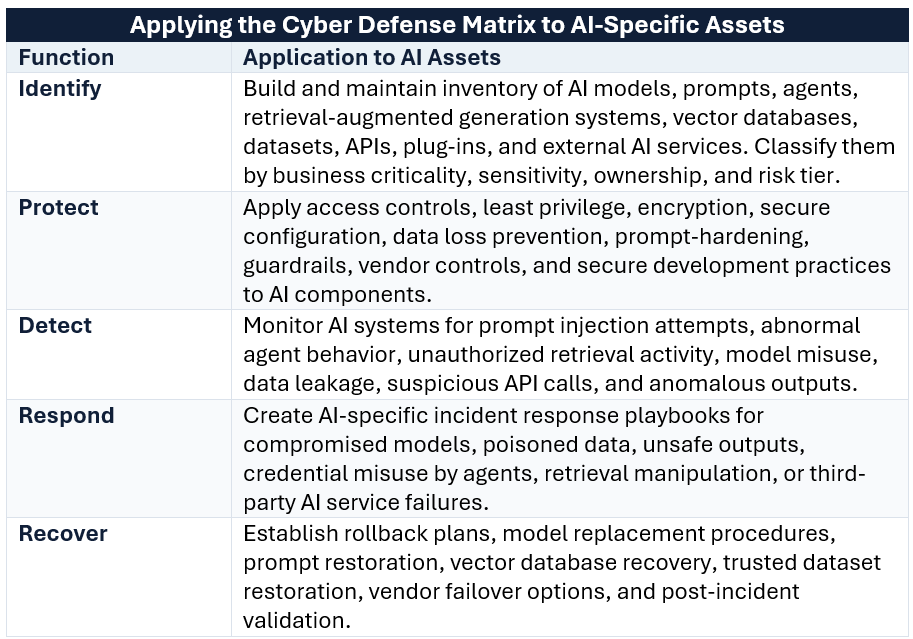
The Cyber Defense Matrix can help leaders organize this expanded attack surface by mapping AI assets to familiar security functions: identify, protect, detect, respond, and recover. It should not be treated as a complete AI governance framework, but it is useful for forcing a practical question: do we know what AI assets we have, what they can access, how they are monitored, and how we would recover if they fail or are compromised?
AI Supply Chains
AI also intensifies supply-chain risk. Modern AI systems may rely on third-party models, open-source components, external datasets, plug-ins, APIs, cloud services, and vendor-managed platforms. Weaknesses in any of these dependencies can affect model behavior, data protection, system availability, and business integrity. Vendor assurance, data provenance, model integrity, contractual safeguards, and monitoring of external services should therefore be treated as core elements of AI security, not procurement afterthoughts (Cybersecurity and Infrastructure Security Agency et al., 2025; OWASP Foundation, 2025).
Priority AI Security Risks for Enterprise Leaders
Identity Deception and Social Engineering
AI can make phishing, impersonation, fraud, and social engineering more convincing. Messages can be personalized, polished, and produced at high volume. Synthetic content can make it harder for employees, customers, and partners to distinguish legitimate communication from malicious activity. Organizations should respond by strengthening identity verification, phishing-resistant authentication, employee escalation paths, fraud controls, and executive procedures for validating unusual requests (Microsoft, 2025; Schmitt & Koutroumpis, 2025).
Prompt Injection
Prompt injection is a material risk for AI-enabled systems because malicious or hidden instructions can influence how an AI application behaves. The risk becomes more serious when the system can retrieve sensitive information, call tools, modify records, or trigger workflows. Organizations should design AI applications so untrusted inputs cannot override system instructions, access controls, business rules, or approval requirements (NIST, 2024; OWASP Foundation, 2025).
Sensitive Data Exposure
AI systems can expose sensitive data through training pipelines, retrieval sources, prompts, logs, model outputs, plug-ins, or poorly governed integrations. The concern is not limited to personally identifiable information. It can include credentials, proprietary business information, legal material, customer records, operational data, and confidential strategy. Data protection must extend across the full AI lifecycle: data selection, training or configuration, retrieval, inference, output review, logging, retention, and deletion (NIST, 2024; OWASP Foundation, 2025).
Supply-Chain Compromise
AI supply-chain compromise can occur through untrusted datasets, vulnerable packages, compromised models, insecure APIs, malicious plug-ins, or vendor weaknesses. Because AI systems may influence decisions and automate actions, compromised components can create consequences beyond ordinary software defects. Leaders should require provenance controls, supplier due diligence, secure update processes, contractual security obligations, and validation before external AI components are used in critical workflows (Cybersecurity and Infrastructure Security Agency et al., 2025; OWASP Foundation, 2025).
Hallucinations and Misinformation
Generative AI systems can produce inaccurate, incomplete, or fabricated outputs. In executive and operational settings, the risk is not simply that an answer is wrong; it is that an organization may act on an answer without verification. High-impact use cases require validation, source review, human oversight, and clear rules about where AI-generated output may inform decisions but not replace accountable judgment (NIST, 2024; OWASP Foundation, 2025).
Model and data integrity deserve explicit attention. AI behavior can be degraded or manipulated through poisoned data, compromised retrieval sources, unauthorized model changes, insecure fine-tuning, or tampered embeddings. These risks may not be visible through traditional security monitoring alone. Organizations should protect training data, retrieval corpora, model artifacts, evaluation datasets, prompts, and embeddings through provenance controls, access restrictions, change management, validation testing, and monitoring for unexpected behavior (Cybersecurity and Infrastructure Security Agency et al., 2025; NIST, 2024).
Excessive Agency
Excessive agency is one of the most important risks as organizations deploy AI agents that can call tools, retrieve information, update records, send communications, or trigger workflows. The issue is not only whether an AI system gives a poor answer. The issue is whether it can take actions that exceed user intent, violate policy, or create downstream harm. Agentic systems require constrained permissions, human approval for high-impact actions, execution logging, tool-use monitoring, and clear limits on autonomous behavior (OWASP Foundation, 2025; NIST, 2024).
What Organizations Must Change
Establish Strong AI Governance
A credible AI security program should align governance, application security, data protection, and third-party oversight. NIST AI risk guidance provides a structure for governing, mapping, measuring, and managing AI risk. The OWASP Top 10 for LLM Applications identifies application-level risks such as prompt injection, sensitive information disclosure, supply-chain exposure, data and model poisoning, excessive agency, and misinformation. CISA, NSA, FBI, and international partners' guidance emphasize secure data practices, supply chain assurance, provenance, monitoring, and protection of AI data across the lifecycle (Cybersecurity and Infrastructure Security Agency et al., 2025; NIST, 2024; OWASP Foundation, 2025).
Governance must be operational, not ceremonial. Organizations need named executive ownership, approved risk appetite, accountable system owners, AI asset inventories, risk categorization, control requirements, escalation paths, and periodic assurance reporting. These mechanisms help leaders decide which AI use cases are acceptable, which require additional controls, and which should be restricted, paused, or retired when risk exceeds tolerance (NIST, 2024; Accenture, 2025).
Create AI Inventories and Risk Tiers
AI risk should be managed across the full lifecycle: design, data selection, model development or acquisition, testing, deployment, monitoring, change management, retirement, and incident recovery. This matters because risk can enter through training data, retrieval sources, prompts, model updates, plug-ins, APIs, user interactions, and expanded agent permissions. A one-time deployment review is not sufficient for systems that continue to change after release (Cybersecurity and Infrastructure Security Agency et al., 2025; NIST, 2024).
Organizations cannot manage AI risk effectively if they do not know where AI is deployed, who owns it, what data it uses, what it can access, what actions it can take, and which business processes depend on it. Inventories should include models, agents, vendors, datasets, prompts, retrieval sources, integrations, APIs, plug-ins, and delegated permissions. Risk tiers should reflect business criticality, data sensitivity, autonomy, external exposure, regulatory impact, and potential harm from incorrect or unauthorized action.
Expand Security Testing
Traditional security testing should be supplemented with AI-focused evaluation methods. These include prompt-injection testing, red teaming, model and agent evaluation, output validation, retrieval testing, data-leakage testing, and resilience exercises. The purpose is not only to find technical flaws, but to determine whether controls continue to function when the system is exposed to adversarial inputs, ambiguous instructions, unexpected data, or misuse attempts (NIST, 2024; OWASP Foundation, 2025).
Develop AI-Specific Incident Response Capabilities
Incident response plans should include AI-specific scenarios: compromised models, poisoned datasets, prompt-injection attacks, manipulated retrieval sources, unsafe outputs, agent credential misuse, third-party AI service failures, and unauthorized tool execution. Organizations should define procedures for containing the issue, suspending affected capabilities, preserving evidence, restoring trusted assets, communicating business impact, and validating recovery before returning the system to service (Cybersecurity and Infrastructure Security Agency et al., 2025; NIST, 2024).
Strengthen Third-Party Oversight
Vendor oversight must expand to reflect AI-specific dependencies. Organizations should evaluate model provenance, data handling, retention practices, incident notification obligations, auditability, security testing, subcontractor use, service continuity, and contractual rights related to model or data misuse. AI suppliers should be assessed not only for technical capability, but for whether their controls match the business impact of the use case (Cybersecurity and Infrastructure Security Agency et al., 2025; OWASP Foundation, 2025).
Security Principles That Still Matter
Least Privilege
Least privilege remains foundational, but it must now apply to agents, tools, retrieval systems, plug-ins, APIs, and service accounts. AI systems should receive only the permissions needed for approved functions, and high-impact actions should require additional verification or human approval (OWASP Foundation, 2025; NIST, 2024).
Identity Security
Identity security remains one of the most important defensive priorities. Authentication, authorization, role assignment, access monitoring, and phishing-resistant controls should extend to both human users and AI-enabled workflows. Leaders should assume identity will remain a primary target as adversaries use AI to make deception more credible (Accenture, 2025; Microsoft, 2025).
Secure-by-Design Principles
Secure-by-design principles should apply from the beginning of AI system development or acquisition. Security should be built into architecture, data handling, testing, monitoring, access control, logging, incident response, and vendor selection. Retrofitting controls after deployment is more difficult when AI systems are already embedded in business workflows (Accenture, 2025; NIST, 2024).
Zero Trust
Zero Trust remains relevant, but it must extend beyond users, devices, applications, and services. In AI environments, Zero Trust should apply to agents, prompts, tool access, retrieval activity, delegated permissions, and autonomous actions. Effective implementation requires least-privilege permissions, policy enforcement before high-impact actions, continuous monitoring of agent behavior, and audit logs showing which user, agent, tool, data source, and action were involved in each transaction (Accenture, 2025; Cybersecurity and Infrastructure Security Agency et al., 2025).
Data Protection
Data protection remains central. Classification, encryption, monitoring, retention, access control, and lifecycle management should apply to training data, inference data, prompts, retrieval sources, embeddings, logs, and AI-generated outputs. AI security cannot be separated from data governance because the reliability and trustworthiness of AI outcomes depend on the integrity and protection of the data that powers them (Cybersecurity and Infrastructure Security Agency et al., 2025; NIST, 2024).
Leadership Recommendations
Leadership should turn AI security from an abstract concern into a managed enterprise discipline. That requires named ownership, approved risk thresholds, measurable control expectations, reporting cadences, and defined criteria for pausing, restricting, or retiring AI systems that exceed acceptable risk. The most effective leaders will ask not only whether an AI system works, but whether the organization can explain, constrain, monitor, and recover it.
Assign executive ownership of AI security, governance, and risk management to ensure accountability does not remain fragmented across technology, security, legal, compliance, and business teams.
Require inventories and risk tiering for AI models, agents, data sources, external services, automated workflows, and delegated permissions before AI systems are deployed or expanded.
Fund AI-specific security capabilities, including threat modeling, prompt injection testing, model and agent evaluation, monitoring of retrieval and tool use, incident response preparation, data protection, and third-party assurance.
Extend vendor risk management to AI providers, model suppliers, plug-ins, APIs, and external services that influence enterprise operations or handle sensitive data.
Hold business units accountable for safe AI adoption by requiring documented use cases, approved data-handling practices, security reviews, and defined ownership before operational deployment.
Leaders should also require assurance metrics that show whether AI security controls are operating effectively. Useful measures include the percentage of AI systems inventoried, the percentage risk-tiered before deployment, the number of unresolved AI security findings, prompt injection test results, vendor assurance completion, incident response exercise coverage, and the percentage of agentic workflows with approved permissions and logging.
These metrics help move AI governance from policy awareness to control assurance. They also give executives a practical way to determine whether AI adoption is advancing faster than the organization can manage the associated risks.
Conclusion
Artificial intelligence is reshaping cybersecurity by expanding the enterprise attack surface, increasing the speed and plausibility of adversary activity, and raising the consequences of weak governance. The leadership challenge is not to replace cybersecurity with a new AI-specific discipline, but to extend mature cybersecurity practices to models, prompts, agents, data pipelines, retrieval systems, third-party services, and the business processes that depend on them (NIST, 2024; OWASP Foundation, 2025).
Organizations should begin with practical steps: identify AI systems, assign accountable owners, tier risk, constrain agency, protect data, test controls, monitor behavior, and prepare for AI-specific incidents. The organizations best positioned for the AI era will not be those that abandon established cybersecurity principles. They will be the organizations that adapt those principles quickly, govern AI deliberately, and demand measurable assurance before delegating trust to automated systems (Accenture, 2025; NIST, 2024).
References
Accenture. (2025, June 25). State of cybersecurity resilience 2025.
Cybersecurity and Infrastructure Security Agency, Federal Bureau of Investigation, National Security Agency, Australian Signals Directorate’s Australian Cyber Security Centre, Canadian Centre for Cyber Security, New Zealand National Cyber Security Centre, & United Kingdom National Cyber Security Centre. (2025, May 22). AI data security: Best practices for securing data used to train and operate AI systems.
Glazunov, S., & Brand, M. (2024, June 20). Project Naptime: Evaluating offensive security capabilities of large language models. Google Project Zero.
Microsoft. (2025). Microsoft Digital Defense Report 2025.
National Institute of Standards and Technology. (2024, July 26). Artificial intelligence risk management framework: Generative artificial intelligence profile (NIST AI 600-1). U.S. Department of Commerce.
OWASP Foundation. (2024, November 18). OWASP Top 10 for LLM applications 2025.
Schmitt, M., & Koutroumpis, P. (2025). Cyber shadows: Neutralizing security threats with AI and targeted policy measures. IEEE Transactions on Artificial Intelligence, 6(7), 1697–1705.
World Economic Forum. (2025, January 13). Global cybersecurity outlook 2025.